Jockey Hollow: A New Jersey Hike Through the Winter That Tested the Revolution

A walk through Jockey Hollow offers an unusual way to encounter the American Revolution: through the landscape that soldiers depended on to survive. Wooded hills, streams, and winding paths now welcome hikers to this corner of Morristown National Historical Park in New Jersey. During the winter of 1779–1780, those same resources helped sustain thousands of Continental soldiers through one of the war’s most punishing seasons.
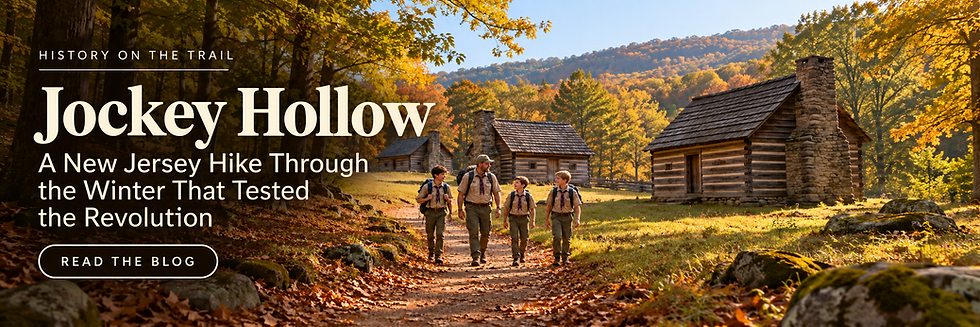
Follow its trails, pause beside the reconstructed soldiers’ huts, and the Revolution becomes a story of shelter, food, endurance, and the difficult work of keeping an army together. (National Park Service: Morristown National Historical Park)
Why Washington’s Army Came to Jockey Hollow
Washington’s officers chose the area for practical reasons. They needed timber for huts and fuel, water for the troops, and roads capable of carrying supplies. Morristown also offered distance from British forces around New York City.
In correspondence reproduced by the National Park Service, Quartermaster General Nathanael Greene weighed these needs carefully. His December 1, 1779, description acknowledged the uneven terrain while emphasizing the available wood and water.
For today’s visitor, those letters give the landscape another meaning. A wooded slope was a source of building materials; a stream was essential infrastructure. The army’s survival depended on how well these features could serve thousands of people at once. (NPS: Documents on Choosing Jockey Hollow)
The Hard Winter of 1779–1780
The winter quickly exposed the limits of those advantages. Roughly 10,000 soldiers encamped in and around Morristown, constructing approximately 1,200 log huts. Heavy snow obstructed supply routes, and shortages of food and clothing became desperate. The National Park Service describes the season as possibly the most severe winter recorded in the early Northeast.
Accounts from the encampment make that suffering tangible. In a January 4, 1780, letter excerpted by the NPS, Greene reported, “Our Army is without Meat and Bread.” Washington’s correspondence likewise described troops repeatedly going without essential provisions.
Washington himself operated from the Ford Mansion in Morristown, separate from the soldiers’ encampment at Jockey Hollow. Visiting both places reveals the physical distance between the army’s headquarters and the huts where most soldiers endured the winter. (NPS: Winter Encampment Summary and Historical Accounts)
The Wick House: A Family Home Becomes Military Quarters
One of Jockey Hollow’s most compelling stops is the Wick House. Henry Wick built the farmhouse around 1750, and his approximately 1,400-acre property included extensive woodland. During the encampment, Major General Arthur St. Clair, commander of the Pennsylvania troops, established his quarters in the family’s home.
The farm also reveals how heavily military survival could burden civilians. According to the National Park Service, soldiers cut more than 600 acres of trees on Wick’s property during the winter, with further cutting on neighboring land. Looking at the woods today, it takes imagination to picture the stripped landscape, constant demand for firewood, and disruption to the household.
The Wick House is a place to consider what happened when a family’s home and livelihood became part of a military camp. (NPS: Jockey Hollow and the Wick House)
Soldiers’ Huts and the Grand Parade
The reconstructed huts offer another perspective on the encampment. These are replicas built to interpret the soldiers’ quarters, rather than surviving eighteenth-century cabins. Their location on the Pennsylvania encampment hillside helps visitors understand how shelter was organized across the terrain.
Nearby, the Grand Parade served as a gathering place for inspections, guard assignments, and drilling. Even amid winter hardship, military routines continued. Walking between these sites helps connect the army’s daily work with its struggle to survive. (NPS: Park Map and Historic Sites)
The Jockey Hollow Trail’s Scouting Tradition
For hikers, an interesting distinction is worth knowing: Jockey Hollow has a network of park trails, while the Jockey Hollow Trail also names a specific historic hiking program associated with Scouting.
That program has a history of its own. According to Patriots’ Path Council, Fred Bruehne and Warren Wheeler of Madison’s Troops 25 and 27 developed the original hike in 1960, and it officially opened in May 1962. The ambitious 17-mile outing incorporated train travel, overnight camping, Jockey Hollow, and Washington’s headquarters.
As development and private property affected the route, the hike was revised into a shorter historic itinerary. The tradition adds another chapter to the landscape: generations of young people have explored the Revolution by walking through its surviving places. (Patriots’ Path Council: Jockey Hollow Trail History)
The council’s published Scout guide lists a route totaling approximately 10.2 miles, linking the Wick House, New Jersey Brigade site, Stark’s Brigade, and soldiers’ huts before returning to the visitor center. It is a substantial outing, and visitors interested in that particular route should consult the guide alongside current park information. Jockey Hollow Trail Guide
Shorter Hikes Through History and Nature
A shorter visit can still deliver plenty of history. The National Park Service recommends the Yellow Trail, approximately 2¼ miles round trip, for historic sightseeing, including the replica huts and Grand Parade.
For a more nature-focused walk, the Blue Trail, approximately three miles, passes Cat Swamp Pond and a scenic overlook on Mount Kemble. These routes make it possible to choose between a compact historical introduction and a longer woodland excursion. (NPS: Self-Guided Visits)
Planning Your Visit
Start with the official Jockey Hollow trail map, which identifies parking areas, trail connections, and visitor facilities. Check current park information for building access and operating hours, particularly if a visit inside the Wick House is part of your plans.
Leave time to stop along the way. At the huts, consider the labor required to build shelter in freezing weather. At the farmhouse, think about the civilians whose resources sustained the army. Along the wooded paths, imagine how thoroughly the encampment transformed the ground beneath your feet.
Jockey Hollow rewards that slower attention. Its history makes an ordinary comfort—a warm coat, a packed lunch, the certainty of shelter at the end of a walk—feel newly significant.


Comments